
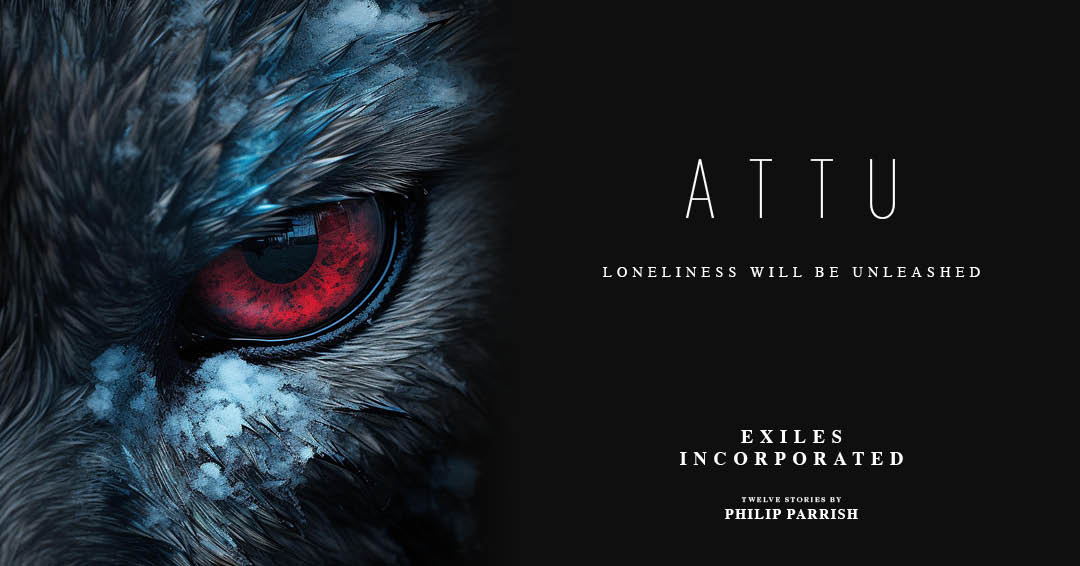
Exiles Incorporated: the opening to Attu

Through twelve evocative tales of longing and loss, Exiles Incorporated depicts a volatile world of hostile landscapes, where humans strive to belong amid the cruelty of conquest, the madness of desire and the transience of love. In the ninth story, set on the Aleutian island of Attu in the 18th century, a mythical creature’s fur inspires a lady to endure a lifetime of cruelty and isolation.
“Tell me a story that will protect me forever.”

The girl’s whisper drowned in silent dark. She snuggled deeper into her blanket. The further I go, the more daddy will want to come back.

“I will always protect you, darling.”

A voice from the blackness. Her mother. No shape, smell or touch. But she was there. Always would be, even in memory. Like the ground beneath her feet and the air lifting her lungs.

“Ours is a love as old as the hills.”

The warm words cloaked the child like soft armour. They were each other’s protectors. Safe in secret spaces only the two of them could go. The deepest cave. The highest peak. The quietest, most contemplative corners of their hearts.

“What if you don’t stay? Like daddy.”

Mother was thinking about that too. That sleep with no end.

“There will come a time when you won’t be here,” probed the girl. “Then I will need your story. For comfort and courage.”

“Comfort and courage. They’re different things.”

“The best stories do both, don’t they? The best people give you both. Like daddy. Before he went away.”

“They do indeed. Very well then. A story. For comfort and courage. A tale you can wrap yourself in till the end of your days.”

Mother’s magic spun slow and terse. She weaved the story from thin air and the confluence of all nature offered. Lapping waves. Hurtling storms. Stubborn rock. Winds blasting barren terrain. A tale as immovable as a mountain; a sleeping stone giant cradling a tiny, fragile mystery within.

“Where are you now, child?”

“I’m with you, mummy.”

“No. That’s not how stories work. Where are you now?”

“In a far-off place.”

“Yes, that’s right. An island.”

“What’s it called?”

“Attu.”

“Where’s that mummy?”

“In the Aleutians. A chain of islands between Russia and Alaska. They curve the top of the Pacific like jewels in a necklace. Attu lies at the most western end. For some it would be nearest east. A lonely place, shrouded in mist.”

White lights blinked in the child’s mind. Twinkling and twisting through patches of thick grey, like ancestral beacons guiding her to safety.

“Attu is called the birthplace of the winds. The Pacific’s warm air meets the frigid currents of the Bering Sea to create huge gales and…”

“And what mummy?”

“No. You need to imagine it yourself.”

Beyond the grey, the little girl saw the island materialise through sheets of hail. The land’s contours rolled like the rise of the hip and the swelling of a breast. Through the tumult came the soft curves of a girl’s face. She had a pretty nose, hungry mouth and dark, fearful eyes.

“Once upon a time, there was a woman in Attu called Amka,” said mother. “When she was a child, her father went away and didn’t come back. But she learned how to protect herself.”

Squawking birds. Splinters of rain. Violent tides ripping on the rocks of blackened bays. Lanterns glowing within tiny shelters made from grass. Families seeking comfort in treeless land. Plants swaying with the whipping winds. Men on shore and at sea, clothed in animal skin. Hunting for crabs, cod and walrus. Mountains crowned in snow, even during the warm seasons, when flowers rushed from the ground under oases of sunlight. Colours died as quickly as they sprung, beauty surrendering to seething gales.

“How did she protect herself, mummy?”

“The secret came to her as a little girl during a bedtime story,” said mother. “Just like this one. A story told by her father. He was tall, strong and gentle. Loving and kind. One night he wrapped her tight in a wonderful gift. To keep her warm from the winds and forever in touch with the land. A magical piece of fur…”

Exiles Incorporated is available to buy on Apple BooksAmazon and Google Play as an e-book, plus on Amazon and Barnes & Noble as a paperback.
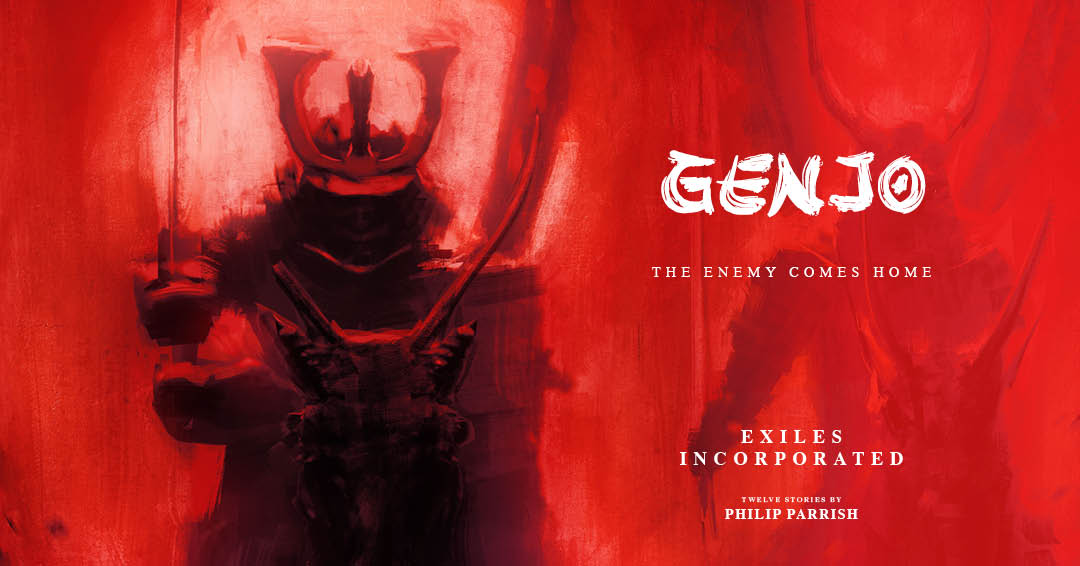
Exiles Incorporated: the opening to Genjo

Through twelve evocative tales of longing and loss, Exiles Incorporated depicts a volatile world of hostile landscapes, where humans strive to belong amid the cruelty of conquest, the madness of desire and the transience of love. In the eighth story Genjo, a retired samurai in 17th century Japan embarks on a fantastical adventure to save his master from a strange madness gripping the land.

“Master is gone,” screeched the monkey as it danced around the well’s mouth between the encroaching weeds.

Genjo spied the unwelcome guest from his tatami mat on the veranda. He kept his eyes open during morning meditation. Embittered rivals could easily slip through the crumbling garden walls and slit his throat, their vengeful laughter rattling through the cherry blossom trees.

“Master is gone. Master is gone.”

The monkey flitted and bobbed; a whirling apparition of grey amid tangled green. As head gardener, Genjo was obliged to tend all parts of Daimyo Keiko’s estate. Letting it descend into an overgrown mess was unbecoming of a samurai, even a retired one. These days, keeping his affairs in order was like trying to carry the ocean in the palm of his hand.

“Master is gone. Master is gone.” 

Keiko had indeed gone. Sankin kōtai required all daimyo to reside in Edo for six months every year. Genjo managed the land in his master’s absence: a mighty exponent of bushido reduced to dealing bushels of rice and timber.

To relieve the boredom, Genjo often gazed across the landscape from Keiko’s hilltop estate and envisioned his younger self, galloping through a sea of red and yellow banners scything down his enemies. Sometimes he sketched his past glories onto canvas, transforming the halcyon scenes swamping his mind into feeble charcoal shadows he could gift to servants.

“Invasion. Abduction. Violence,” screeched the monkey. “Your master has gone, I tell you. Your master has gone.”

A talking monkey.Of all things. But these were unusual times. Rumours bubbled up from the valley’s peasants that a strange madness had gripped the land, the source of the poison unknown. Japan expelled foreigners years ago yet remained tormented by ghostly sightings of fantastical beasts. Bearded men with bodies of dragons wallowing in rolling red fog. Flying fish attacking birds. Squid-like creatures squelching through woods, eyes glowing in the dark.

The monkey hopped and squawked. Genjo contemplated snatching the irritant’s tail, twisting its neck and tearing it in two like a sheet of paper. Rising from his knees with a grimace, he wiped the saliva from his chin and watched the garden sway like a ship’s deck in a storm. He placed his palm on the marble statue of Lord Buddha and let the dizziness pass.

“Mind your head,” hissed another voice. “Mind your head.”

Startled, Genjo scanned the length and breadth of the garden. A faraway ripple of queer laughter, then stillness. Apart from himself and the primate, the estate was empty of sound, save for the dripping of residual rain from the roof shingles.

Not bothering to tie his maroon silk robe across his sagging belly, Genjo strode to the well. It resembled one from a queer folk tale he once read as a child. A hole in the ground from which strange monsters might slither, their slimy tails curling off the page to encircle his mind.

“Monkey man, you imbecile,” he scoffed as he parted the waist-high weeds. “I know your kind. A sly devil. A symbol of foolishness. A weedy string of an animal. Yet you attempt to worry a samurai. And most heinous of all, you disturb him while in meditation with Lord Buddha.”

The monkey stopped dancing. Standing on its hind legs, tail drooping between its feet, the visitor waddled to Genjo’s side of the well. The creature pushed its face to the samurai’s nose and yawned, a damp stench wafting through grimy yellow teeth.

“Oh you must worry, my gentle Genjo,” it said. “The realm you cherish is possessed. Your daimyo has been captured while journeying back from Edo. An evil spirit has claimed Keiko.”

Exiles Incorporated is available to buy on Apple BooksAmazon and Google Play as an e-book, plus on Amazon and Barnes & Noble as a paperback.

Exiles Incorporated: the opening to Janeiro

Through twelve evocative tales of longing and loss, Exiles Incorporated depicts a volatile world of hostile landscapes, where humans strive to belong amid the cruelty of conquest, the madness of desire and the transience of love. In the seventh story Janeiro, set in 16th century Brazil, a conflicted Jesuit and a bullied Tupi lady forge a union that transcends time and space.

Drifting towards each other from opposite directions, the two strangers arrived at the blackened plant in the wasteland together. The charred tree stump jutted six inches from the ashes, like a dark fist punching through the earth. It was the solitary landmark in the grey, waterless plain, save for the depression in the ground where the river once ran.

“The source of the signal.”

“Could do with watering.”

“Your kind have a sense of humour, then.”

The stump’s top, shorn flat during deforestation, was a smooth black surface without growth rings. The moon’s reflection lay suspended in its centre.

“You really think this is where it happened?”

“It was a different time back then.”

Together they imagined an emerald landscape of trees, villages and colonial ships prowling the coastline. Now there was no coast. Greed and fear had long since burned away nature’s nervous system, leaving only a petrified expanse smothering the earth.

“At least there’s nobody left to torch outsiders.”

“This resisted the fire.”

“Just about.”

“Why them? They were nothing special.”

“Special enough to induce an extreme reaction. The last of its kind.”

“Or the first.”

The strangers let their breaths intertwine over the burnt wood.

“It’s still alive.”

“How do you know?”

“We’ve started speaking the same language.”

***

Everyone understood the command, no matter where they came from. The Governor-General demanded mercenaries pack the cannons with gunpowder. Grim circular faces of heavy iron cylinders pointed across the bay, so militia on the fortress turrets could unleash fire on rival colonialist ships. After all cannonballs were exhausted, the men would count the driftwood on shore. Routine would return. Unoccupied hours watching the rivers emerge like open veins from corpulent emerald country.

A fragile peace held on this strip of South American coast. Swords and smallpox had quelled the indigenous Tupis. Taking their place were merchants, artisans, farmers and slaves. Degregados too: miscreants fleeing their motherlands to suck the breast of the new world. Compliant Tupi lived in new mission villages on the plateau. Several toiled at sugar plantations up the coast. Others slaved on ships bound for Europe, loading the vessels with nature’s bounty from tortoise shells to topaz. Many had fled deeper into the brooding forest.

The settlement was named Rio de Janeiro. River of January. A natural wonder first seen by European eyes on the first day of the first month. A new channel through which earthly riches and God’s love could flow in abundance. Spearheading the advance were the Jesuits. They’d braved the Atlantic to teach Christianity, Portuguese and Latin to the Tupi, so the savages could savour the sweetness of God’s language on their tongues.

Some settlers were less convinced. Lonely exiles from the old world sensed holy words might run aground here. In the stillness after supper, drifters meandered towards each other around jittering fires. Speculation ensued as to what lay in the forest’s guts, from two-headed monsters to voluptuous witches drinking the blood of their young. Some conjectured the forest may even be one enormous creature. To wound one leaf would be to wound them all, provoking an earthly wrath that would freeze speech and curdle the soul.

Under a full moon, tensions thickened. Mirthful evening chatter tapered to silence and ended with twitching gazes into the dark. Panicking flickers of white light appeared in the trees then dissolved. Seething spasms of sound rumbled from the unsettled water. Branches creaked and stretched, like the forest’s nerve endings craved new sensations in the tender air.

The last to fall asleep dreamed the moon and the earth were in dialogue. The two celestial objects shared an alien language, the visions went, channelled through primeval waterways that pleaded for an intimacy neither describable in words nor conceivable in the mind.

Exiles Incorporated is available to buy on Apple BooksAmazon and Google Play as an e-book, plus on Amazon and Barnes & Noble as a paperback.

Exiles Incorporated: the opening to Rumi

Through twelve evocative tales of longing and loss, Exiles Incorporated depicts a volatile world of hostile landscapes, where humans strive to belong amid the cruelty of conquest, the madness of desire and the transience of love. In the sixth story Rumi, a pickpocket in medieval Cairo braves a sandstorm in search of a mysterious golden house offering treasures beyond imagination.

I’ll tell you its name, as long as you don’t expect to hear mine. A khamsin it’s called: a giant sandstorm blanketing markets, mosques and mausoleums in blinding swathes of ochre. A thing with no face or shape. Exceeded in power, according to some, only by the breath of Allah. But I don’t believe in the divine. Dirty air is the only thing blowing through my hollow body. 

As afternoon fades, a khamsin sweeps Cairo. The breeze stiffens. A hush slithers the streets. Bartering ceases in the souks. The city empties of ritual and every abandoned pot, place and pathway is suffocated by the desert’s veil.

I emerge from the bazaar to confront the beast. Storm winds blast my slim frame. I shield my eyes with the back of my hand. My headscarf covers the rest of my face. In my profession, it doesn’t pay to be recognised. Stooping, I cup a handful of sand in my palm. Removing the scarf, I blow tiny desert shards back where they came, observing them scatter, dip and disappear.

So with sand, so with people. People, politicians, princes. Husbands, wives, lovers. They come. They go. Only two powers thrive in a khamsin. The first is chaos. The second is me. I know how to be in the right place at the right time. In Cairo, you learn to grasp whatever there is. See opportunities where others feel fear. If you don’t, life beats you into a corner, where you cower at the mercy of a deranged shadow who screams at you not to move.

Every day I circle the Qasaba. Through the stench of sweat, spices and incense, I sniff for easy wealth hanging from low branches like ripe fruit. The sandstorm within never settles. I am the world’s thirstiest person. Not for water, but for coin. The precious circles around which everything revolves. My wispy motions slip unnoticed through crowds. My sound is soft; my disarming eyes forever watch the world. Let me lead you on a merry dance, they say.

A beggar buys a date. He drops the money into a pot. A boy slips his arm inside, snaffles the coin and runs into a bazaar past a woman thieving fur to seduce a soldier. She steals into an alley and steps over another beggar. The wretch hasn’t received anything today, until a city official throws scraps to him on his way to prayers. Treasure chests all of them, ready to be unlocked. I draw so close I can smell my prospects’ breaths. They barely notice me, until they waken to what’s happened. Pickpockets must be as cold as the Nile in winter.

Many revere the mystery of the pyramids. I idolise the legend of the Sphinx. Freedom lies in perplexity; the art of sending my victims’ minds spinning. Especially those too naïve for Cairo. My only emotion is disdain. My only impulse greed. My only path flowered with profit. The one thing I won’t steal is someone’s breath. Not even my former master’s. There is not much sport in murder. The victims can never look back and realise what’s been taken.

Exiles Incorporated is available to buy on Apple BooksAmazon and Google Play as an e-book, plus on Amazon and Barnes & Noble as a paperback.

Exiles Incorporated: the opening to Amrita

Through twelve evocative tales of longing and loss, Exiles Incorporated depicts a volatile world of hostile landscapes, where humans strive to belong amid the cruelty of conquest, the madness of desire and the transience of love. In the fifth story Amrita, set in 10th century India, a memorial banquet for a dead princess unleashes demons from the past.

Springtime in Karnataka awakened the appetites of the gentlest souls. Nature’s sweet light planted tender kisses on the earth’s upturned cheek, drawing lusty colour from a pallid world too long cooled. On the Krishna’s banks new life stiffened to the sky in shoots of green and yellow, as the holy river tinkled in the rays of the blessed sun.

Regeneration’s fragrance caressed all, inclining budding lovers to lay their noses together and inhale the finest pleasures of the turning world. Those at the beginning of life’s rotation thought it would last forever. The old, broken by fortune’s wheel, knew otherwise. While nature’s palette sent the young blind, aged souls saw through the haze to the pain of loves past. Listening to the Krishna hush and hiss, elderly wanderers contemplated their imminent return to the source of all things, dreaming of rebirth in a kinder world.

Beside the river, deep in the wrestling trees, lay the warlord Bhaavik’s palace: an intimidating lair which rose through the mangroves in columns and domes of brooding grey marble. Bhaavik was the region’s most venerated ruler, renowned for lavishing goodwill on loyalists and the ruthless oppression of foes.

Nestled above his stony face was a disorderly mane of black hair; below it an extravagant beard reaching his barrelled chest. Bhaavik was greedy and impulsive. On the battlefield, in the banqueting hall and on his bed, the chieftain consumed all before him, swallowing acquaintances into his body politic and spitting out scraps for swooping cormorants.

His wife Amrita was the only creature who could tame him. A gentle zephyr of ghostly blue eyes, polished skin and chestnut hair, she invigorated every room she swept with her sweet tongue and generous manner. Jealous ladies searched behind her opulent saris of brown, olive and gold for a blemish to her body or character. They found only frustration: a pious lady, skilled dancer and accomplished musician with a zealous conviction in the healing power of fine food. Romantic to the deepest wells of her heart, Amrita vowed to immolate herself on Bhaavik’s funeral pyre when the time came, so their ashes would burn in a union no monsoon could extinguish.

Then one spring Amrita withdrew into her chambers, refusing food and water. Meek and sallow, she seemed unable to articulate the source of her pain. Medicine men were summoned to no avail. Her emaciated decline culminated in tragedy. One evening, after an unexpected walk in the palace grounds, she entered the kitchen, stole a bottle of snake poison used to kill vermin and locked herself in her bedroom. Bhaavik broke down the door and ran to his lifeless queen, his howl was heard in the Himalayas.

While Amrita’s corpse lay in a white marble mausoleum in the prettiest part of the gardens, her spirit was said to possess the palace’s food and furnishings. For the name ‘Amrita’ meant eternal life, and many prophesied their beloved lady would one day return to bathe the community in grace.

Exiles Incorporated is available to buy on Apple BooksAmazon and Google Play as an e-book, plus on Amazon and Barnes & Noble as a paperback.
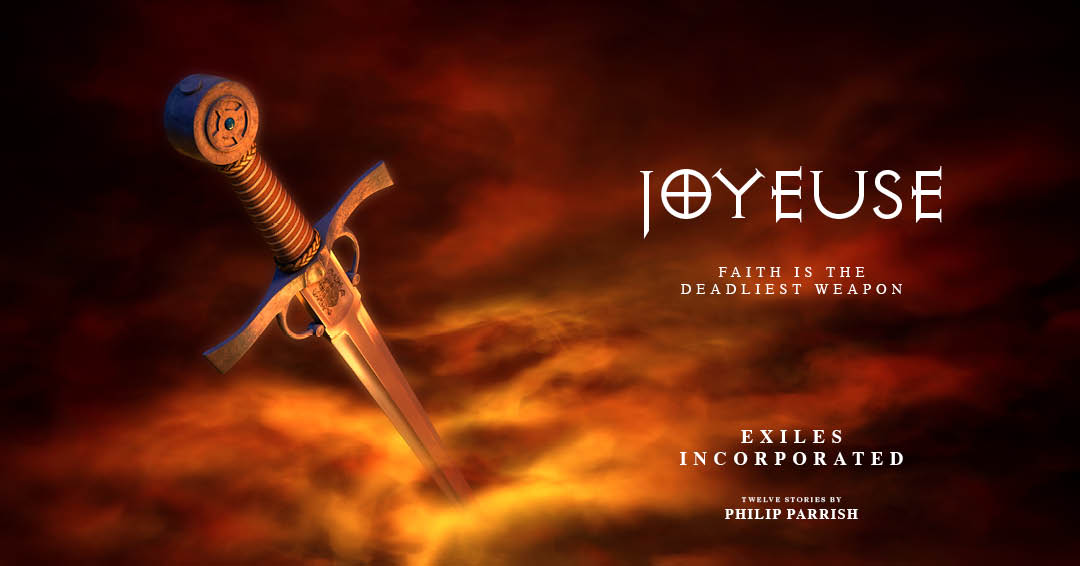
Exiles Incorporated: the opening to Joyeuse

Through twelve evocative tales of longing and loss, Exiles Incorporated depicts a volatile world of hostile landscapes, where humans strive to belong amid the cruelty of conquest, the madness of desire and the transience of love. Set at Christmas time in Rome 800 AD, the fourth story Joyeuse is the tale of two elite soldiers who pursue a lethal love affair against the backdrop of Charlemagne’s imperial coronation.

Our union began on the most joyous of days and ended on the most savage. For the power of the cross is like the power of the sword, until you can’t see which is deceiving which on the descent into fire. An elite soldier should never drop his guard. On Christmas Day in Europe’s holiest city, I lowered mine, letting a higher love lower its beguiling veil and thrust its lance into my heart.

My name is Benoît. I was twenty years old when I became a soldier in Charlemagne’s army. A provincial boy from the green fields of the west swishing swords with the Frankish aristocracy. I was unnaturally strong and mentally agile, anticipating opponents’ moves and striking at the canniest of moments. In combat I envisioned myself a snarling dragon with angelic grace. Soon a mystique swirled around me, and I was happy to wear its magic fabric.

I have always believed in miracles.

Within a year I was a member of the Scara, an honour usually reserved for the finest warriors from the wealthiest families. We protected Europe’s most powerful man; his strongest, quickest and most ruthless soldiers. The most prone to adulation. The most likely to be betrayed by a kiss. An accomplished swordsman reads what isn’t there and acts upon it. A doomed one reads too much and is confounded.

The omens said I would be a warrior of faith. My arrival in this world was heralded by a knight’s sword driven into the door of a rural church in Aquitaine. Stirred from his crypt by the sound, Michel the priest surfaced to see my infant form mewling on the steps, steel shaft and gold hilt vibrating above my head. I was hot to the touch. A trio of ravens watched from the churchyard wall and a nearby oak tree flamed white with fire. Michel, a performer of piety who secretly loved the occult, believed I was a changeling.

“You’re a gift from the shadow world,” he whispered. “As bright, blinding and powerful as the sword which came with you. You have cured me of my loneliness, boy. Rescued me from this enduring chill.”

Or so I was told. To me, it doesn’t matter where you’re from. Only what you do. Whatever happened to my birth sword, or if it even existed, I could not say. Some stories are useful, others less so. While the uncivilised villagers feared folk tales of demons and goblins, I flourished above a well of wisdom. In the crypt, I absorbed the great literature of antiquity, scrutinised the scriptures and pledged my sword to God.

“This is all a show,” Michel warned of the Gospels. “All a show.”

The Bible was his virtuous pretence, the glory of Rome his passionate vice. On winter evenings, he would light candles and tell tales of Tiberius, Caligula and Nero. I dreamed of escaping servitude’s swamp to lead an army into that fabled city where Caesar was slain and Peter martyred.

I have always preferred the company of men. Those who enjoy mine rarely forget it.

Exiles Incorporated is available to buy on Apple BooksAmazon and Google Play as an e-book, plus on Amazon and Barnes & Noble as a paperback.

Exiles Incorporated: the opening to Nazca

Through twelve evocative tales of longing and loss, Exiles Incorporated depicts a volatile world of hostile landscapes, where humans strive to belong amid the cruelty of conquest, the madness of desire and the transience of love. In the third story Nazca, set in the dry plains of first-century Peru, two teenage girls are commanded to ensure rainfall by completing one of the Nazca geoglyphs.

It was another dry morning and nothing much was happening in the sky. The community had buried its leader the night before, merrily watering the ground with fluids as his spirit soared. When dawn broke, younger folk expected to see his happy red face floating in the clouds, but the endless blue offered only wispy white. Men refused to emerge from their huts. The strongest claimed to be sick with grief. The weakest were too poorly to release anything but hot air.

Caya knew it was the shaman’s broth. The demented old fool seemed distracted when mixing the snake blood into the stewing pot and incantating to the Great Being. Only men could sup the maroon drink. Only men fell sick. As the sun rose over the plain, Caya noticed how her mother exchanged a knowing smile with other women as they fluttered through their chores like fledging birds.

One day I will be like them, thought Caya as she swept outside her family’s hut. She glanced down the track to see if Yavi was up, sunlight glinting on his broad shoulders. If he was curled in bed whimpering, she’d be disappointed. And angry with his parents for letting him touch the broth. He was a boy. One day he would be a man. She needed him strong, healthy and wise.

One day. When her chest was bigger, hips wider and the bleeding had begun. Caya was worryingly late. Her friend Mita became a woman last summer, welcomed into the bosom of those squawking ladies who flapped around the shaman. Caya turned the brush upside down and used the handle to draw a picture of herself and Yavi embracing. It looked silly, so she swept it away.

Last night was silly too. The broth had crippled father. Caya peered into her parents’ room and saw him face down with a damp cloth on his bald head. She could smell his insides. Above the bed was the wall hanging of the Great Being with its string of ugly heads, cavernous eyes and snake-like tongues. The colours were pretty, though. Woven into pretty patterns by pretty women’s hands. The ones who cooked, cleaned and swelled with new life. The real rainmakers.

Once when she was tiny, Caya experienced sky water. Infrequent taps on the roof during a sleepless night. A child then, far away from adulthood. Now she was neither. Unready to be a rainmaker, as her father kept telling her. She must bleed first so her insides could receive the male seed. On this morning’s evidence, she would be surprised if any men could summon the strength.

After finishing the cleaning, Caya walked past Yavi’s hut. Her heart quickened. She lingered for a while, drawing another picture of them both in the ground with her fingertips. Nobody emerged. Bored, she wandered to Mita’s hut. Her mother, a grumpy fat lady who shouted at people all day, said Mita was with the shaman learning the ways of the sky. Eventually the Great Being would flood the dry land with life. Not yet though. One day.

Drifting to the outermost huts, Caya saw the other settlement in the distance. There’d been another falling out, because they hadn’t sent anyone to mourn the leader. Caya wondered if their shaman was more capable. Surely it would be better if they all prayed together, so they could take flight as one to see beyond the air.

Exiles Incorporated is available to buy on Apple BooksAmazon and Google Play as an e-book, plus on Amazon and Barnes & Noble as a paperback.